You never expect to wake up one morning and realize that your health has changed your life. One day, you are working, providing for your family, and living independently. The next day, a medical condition or injury has made it impossible to continue working as you once did. Bills continue to arrive, rent or mortgage payments are due, and the stress of an uncertain financial future can feel overwhelming. This is where understanding the Social Security Disability Insurance (SSDI) process is helpful.

Need a Social Security Disability Lawyer in Bowling Green, Ohio? We Can Help
The Reality of Applying for Social Security Disability Insurance
Applying for SSDI in Bowling Green, Ohio is rarely as simple as it seems. Many people assume that if their doctor says they cannot work, the Social Security Administration (SSA) will automatically approve their claim. Unfortunately, the process is far more nuanced. The SSA has strict definitions of disability and eligibility criteria that go beyond your current ability to perform your job. Missing a detail or failing to submit the correct documentation can result in months or years of delays, denials, and appeals.
Defining Disability According to Social Security
Social Security defines a disability as a serious medical condition that will either result in death or has lasted, or is expected to last, for at least twelve months. Claimants must provide medical documentation, including medical records, test results, and statements from their treating physicians, to substantiate their condition. Simply feeling unable to work is not enough. Every piece of evidence contributes to building a case that meets the SSA’s strict requirements.
Determining Your Eligibility
Several factors determine whether you qualify for SSDI. Your age, work history, income, and medical limitations all play a role. Understanding these criteria early can save you time and frustration.
Work Credits
To be eligible for SSDI, you must have earned sufficient work credits in the past ten years. The SSA uses these credits to measure whether you have contributed enough to the Social Security system to qualify for benefits. The fastest way to determine your work credits in Bowling Green, Ohio is to call Social Security or to set up an online account via Social Security.
Substantial Gainful Activity
Even if you are struggling to work, earning above the substantial gainful activity (SGA) threshold may disqualify you. For non-blind applicants in 2024, earning $1,550 per month or more can prevent approval. Determining whether your current income counts as SGA can be confusing, but an experienced attorney can help clarify the rules.
Medical Limitations and Age Considerations
Your ability to perform work-related activities is closely evaluated. Physical and mental limitations are reviewed in detail, including whether your condition prevents you from performing tasks like standing, lifting, or concentrating. Age is also considered. Social Security recognizes that individuals over 55 may face greater difficulty adapting to alternative forms of employment, which can affect their eligibility.
The Social Security Disability Process in Bowling Green, Ohio
The Social Security disability process involves multiple stages, and understanding each step can reduce stress and uncertainty. A successful claim approved on the first application may be resolved in as little as 3–6 months. However, if your case requires appeals and a hearing, then the process can extend to two years or more. The total timeline depends on how many stages of appeal are needed.
Initial Application
The first step is the intake process, which can be completed online or over the phone. This initial application typically takes three to six months for a decision.
Reconsideration
If the SSA denies your initial claim, then you can file for reconsideration. This involves a complete review of your medical evidence by a different SSA representative and usually takes another three to six months.
Administrative Law Judge Hearing
Should reconsideration be denied, you can request a hearing with an Administrative Law Judge. Waiting for a hearing can take about a year. The judge will review your case and consider testimony from you and potentially a vocational expert. Decisions may take a few months to be finalized after the hearing.
Appeals Council and Federal Court
If the ALJ denies your claim, then you may request a review from the Appeals Council, which can take up to a year. If denied again, then you may file a federal court appeal. This step is highly technical, focusing on whether Social Security followed its own procedures rather than reevaluating the medical evidence.
When to Contact a Social Security Disability Lawyer
Many applicants can handle the initial application independently, but consulting a local SSDI attorney becomes imperative if your claim is denied. An attorney can guide you through the appeals process, ensuring that all medical records and documentation are correctly submitted and presented.
Having an attorney can also reduce the stress of testifying before a judge and navigating complex procedural rules. Your attorney can speak on your behalf, cross-examine vocational experts, and gather additional witnesses if needed.
Affording an SSDI Attorney
Facing financial difficulties while waiting for Social Security benefits can make hiring an attorney seem impossible. We work with you on a contingency basis, meaning you only pay if you receive benefits. This arrangement enables you to access beneficial legal representation without incurring upfront costs.
An SSDI Attorney in Bowling Green, Ohio Can Improve Your Chances
Having an experienced SSDI attorney guide you through the appeals process may speed up the process. Attorneys understand what evidence the SSA requires, how to present it effectively, and how to prepare you for hearings. This guidance can make the difference between a prolonged denial and receiving the benefits you need.
Arthur Law Firm Fair & Square Fee Guarantee
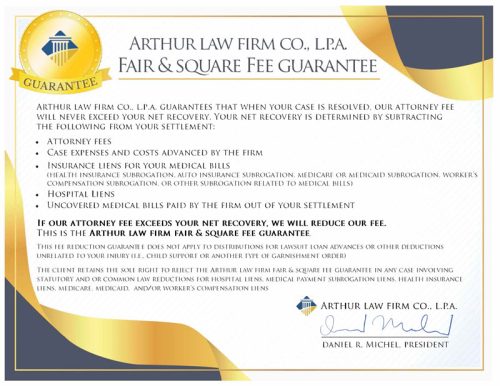
At Arthur Law Firm, we know firsthand that sometimes a settlement can’t cover all the out-of-pocket expenses a person incurs after an accident. Our Fair & Square Fee Guarantee is a commitment to you that our fee will never exceed your net recovery when your case is resolved.
Taking Action in Bowling Green, Ohio
Navigating the social security disability appeals process can be overwhelming, but you do not have to face it alone. Residents of Bowling Green, Ohio, who are struggling with a disabling condition rely on us. We understand both the law and the local resources available. Every step requires careful preparation, documentation, and advocacy.
At Arthur Law Firm, we can help you through the process so you can focus on your health while we handle the legal complexities of your claim. Contact us today at 419-782-9881 for a free consultation and take the first step toward securing the benefits you deserve.