
Archbold, Ohio SSDI Attorney for Denied Disability Claims
When a medical condition prevents you from working, the financial uncertainty can be just as difficult as the condition itself. You may be unable to earn the income your household depends on while still facing medical expenses, monthly bills, and everyday costs.
Social Security Disability Insurance (SSDI) may provide financial support to people whose medical conditions prevent them from maintaining substantial employment. However, qualifying for benefits requires more than showing that you have a medical diagnosis. The Social Security Administration evaluates your medical limitations, work history, ability to perform other work, and other factors before making a decision.
For residents of Archbold, Ohio, navigating these requirements can be difficult, particularly if your initial application has been denied. Understanding how Social Security evaluates disability claims and what options may be available after a denial can help you determine your next steps.
Social Security Has a Specific Definition of Disability
Meeting the medical requirements for SSDI involves more than demonstrating that you are sick or injured.
Your condition generally must prevent you from performing substantial gainful activity and be expected to last at least 12 months or result in death. A condition that prevents you from working for only a few months may not meet Social Security’s disability standard.
Social Security may also consider whether you could perform other types of work based on your medical limitations, education, skills, and previous work experience.
As a result, being unable to return to your previous job does not necessarily establish eligibility. The agency may consider whether your limitations prevent you from performing other substantial work as well.
How Age and Vocational Factors Can Affect Your Claim
Your ability to adjust to different types of employment can become an important consideration during an SSDI evaluation.
Social Security may consider your age along with your education, transferable skills, and vocational background when determining whether you can adjust to other work. Changing occupations may be more difficult for some workers, particularly when medical limitations affect the types of work they can perform.
These factors can make disability evaluations more complicated than simply determining whether you can return to your previous occupation.
A complete SSDI claim should address how your medical limitations interact with your work history and other vocational circumstances.
Your Work History Helps Establish SSDI Eligibility
SSDI is tied to your work history. Workers earn Social Security credits by working and paying Social Security taxes, and those credits help determine whether someone meets the work history requirements for disability benefits.
The number of credits required varies based on factors including your age and when you became disabled. Reviewing your work history can therefore be an important early step when determining whether you meet the basic eligibility requirements.
If you are uncertain about your work credits, then you can review your information through your Social Security account or contact the Social Security Administration.
Having enough work credits does not automatically qualify you for SSDI. You must also meet Social Security’s definition of disability.
How to Handle an SSDI Denial?
An SSDI denial can be frustrating, particularly when your condition prevents you from working. However, receiving a denial does not necessarily mean you are not eligible for benefits.
The Social Security disability process includes several levels of appeal. Depending on the circumstances, you may have an opportunity to request reconsideration, appear at a hearing before an Administrative Law Judge, request review by the Appeals Council, or seek federal court review.
An appeal may provide an opportunity to submit additional medical evidence, updated evaluations, or more detailed information about your functional limitations. It can also allow you to address issues identified in the original decision.
Because deadlines apply throughout the appeals process, it is important to review your denial and understand your options promptly.
Let Us Help With Your SSDI Appeal in Archbold, Ohio
A disability can affect your ability to earn an income and create uncertainty about your family’s financial future. SSDI benefits may provide important support when a medical condition prevents you from maintaining substantial employment.
If Social Security has denied your application, then you may still have options. An appeal can give you an opportunity to address problems with the original claim and provide additional evidence supporting your disability.
Arthur Law Firm helps SSDI applicants in Archbold, Ohio understand the disability process and pursue the benefits they may be entitled to receive.
If your SSDI application has been denied and your medical condition prevents you from maintaining substantial employment, then contact Arthur Law Firm at 419-782-9881 to discuss your claim. We can review your situation, explain your options, and help you determine the best next step forward. Filing an SSDI appeal on your own can be overwhelming, but we can help you.
Arthur Law Firm Fair & Square Fee Guarantee
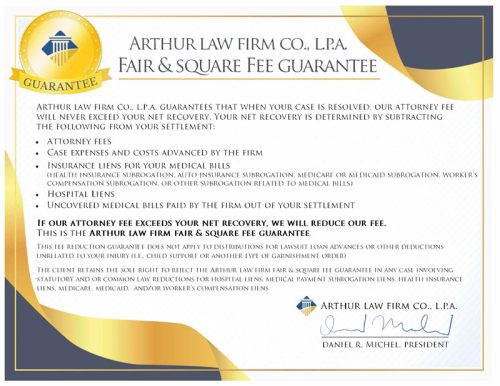
At Arthur Law Firm, we know firsthand that sometimes a settlement can’t cover all the out-of-pocket expenses a person incurs after an accident. Our Fair & Square Fee Guarantee is a commitment to you that our fee will never exceed your net recovery when your case is resolved.
Frequently Asked Questions About SSDI in Archbold, Ohio
Can I work part-time and still qualify for SSDI?
Working while applying for SSDI can affect your eligibility depending on your earnings and circumstances. Social Security considers substantial gainful activity when evaluating disability claims. An attorney can review your situation and explain how your current work may affect your claim.
How long can an SSDI claim take?
The timeline varies depending on the circumstances and stage of the claim. An initial application may take several months, while an appeal can take considerably longer. Many cases take at least 18 to 24 months to resolve.
What conditions qualify for SSDI?
Physical and mental health conditions may qualify when they are severe enough to prevent substantial employment and meet Social Security’s requirements. Having a particular diagnosis does not automatically guarantee approval.
Can my doctor determine whether I qualify for SSDI?
A doctor’s opinion can provide important evidence, but the Social Security Administration makes the final determination. The agency considers medical evidence, functional limitations, vocational factors, and applicable disability requirements.
Is filing an appeal after an SSDI denial worth it?
An appeal may be appropriate if you believe your medical condition prevents you from maintaining substantial employment. Some claims that are initially denied are later approved through the appeals process after additional evidence is submitted or issues with the original application are addressed.