
Social Security Disability Attorney for Oregon, Ohio
When an injury or medical condition keeps you from working, losing your paycheck can create immediate financial pressure. Mortgage or rent, utilities, groceries, medical expenses, and other bills do not stop simply because you can no longer work.
Social Security Disability Insurance (SSDI) can provide monthly income to qualifying workers whose medical conditions prevent them from maintaining substantial employment. However, Social Security disability benefits are not automatically granted because you have a serious diagnosis or have been told by your doctor that you cannot work.
The Social Security Administration evaluates disability claims based on specific requirements involving your medical condition, work history, functional limitations, and ability to perform other types of work. If you live in Oregon, Ohio, then understanding these requirements can help you make informed decisions about applying for benefits or appealing a denied claim.
SSDI Eligibility Is Based on Your Work Record
SSDI is an insurance program connected to your employment history. As you work and pay Social Security taxes, you earn work credits that can help you qualify for disability benefits.
The number of credits you need depends in part on your age and when your disability began. Because of this, two workers with similar medical conditions may not have the same eligibility based on their work histories.
Your work record is only one part of the process. Having enough work credits does not automatically establish that you qualify for SSDI. You must also satisfy Social Security’s definition of disability.
If you are unsure whether your work history meets the requirements, then you can review your Social Security records or seek guidance about your eligibility before moving forward with your claim.
Social Security May Look Beyond Your Previous Job
One of the more difficult parts of an SSDI evaluation is that Social Security may consider whether you can perform other work, not just whether you can return to your previous occupation.
The agency may evaluate your residual functional capacity, which refers to what you are still able to do despite your medical limitations. This can involve physical abilities, mental abilities, and other work-related functions.
Your ability to lift, carry, stand, walk, sit, use your hands, concentrate, remember information, interact with coworkers, or maintain a regular schedule may all become relevant depending on your condition.
Social Security can then consider whether your remaining abilities would allow you to perform other work.
This is why explaining your limitations accurately is important. Saying that you cannot perform your old job may not provide enough information to establish that you cannot maintain other substantial employment.
Age, Education, and Job Skills Can Matter
Your vocational background can also affect how Social Security evaluates your ability to transition into different work.
The agency may consider your age, education, past work experience, and skills when determining whether you can adjust to other employment. Your previous jobs may have given you skills that could transfer to another occupation, or your medical limitations may make it difficult to use those skills in a different setting.
Age can also become a factor in determining how easily someone may be expected to adapt to a new type of work.
What Does Social Security Mean by Disability?
Social Security uses a specific standard when deciding whether someone is disabled. Being unable to perform your current job does not automatically mean you meet the agency’s definition of disability.
Generally, your medical condition must prevent you from performing substantial gainful activity and must have lasted, or be expected to last, for at least 12 months or result in death.
Social Security may also determine whether you have the ability to perform other work. This means an evaluation can involve much more than whether you can return to the position you held before becoming disabled.
Your Medical Condition Must Be Supported by Evidence
Medical evidence plays an important role in an SSDI claim. Social Security may review records from physicians, specialists, hospitals, therapists, and other healthcare providers to understand the nature and severity of your condition.
Your records may document your diagnosis, symptoms, treatment, medications, testing, and response to treatment. They may also help establish how long your condition has affected you.
However, simply providing a diagnosis may not fully explain why you cannot work. A strong claim should help demonstrate the connection between your medical condition and your specific functional limitations.
For instance, medical evidence may help establish that pain limits how long you can sit or stand, that medication causes significant side effects, or that a cognitive condition interferes with concentration and task completion.
Consistent medical treatment can also create a record showing how your condition has progressed and whether limitations have continued despite treatment.
What Happens If Social Security Denies Your Claim?
A denial can be discouraging, especially when you have already stopped working because of your condition. It is important to understand that a denied SSDI application does not necessarily mean you cannot receive benefits.
Social Security provides an appeals process that allows applicants to challenge unfavorable decisions. Depending on where your claim is in the process, you may be able to request reconsideration, ask for a hearing before an Administrative Law Judge, seek Appeals Council review, or pursue a case in federal court.
An appeal can also provide an opportunity to submit additional medical documentation and clarify information that may not have been adequately presented with the original application.
The reason for the denial matters. Reviewing the decision can help identify what Social Security found lacking and what evidence or arguments may be needed to address those issues. Because appeals have deadlines, waiting too long after receiving a denial can put your ability to pursue the next stage at risk.
Why Work With an SSDI Attorney in Oregon, Ohio?
The Social Security disability process can be difficult to manage on your own, particularly if you are already dealing with a serious medical condition.
At Arthur Law Firm, we can help Oregon, Ohio residents understand their options after an SSDI denial. We can review the decision, help gather supporting documentation, keep track of applicable deadlines, and present information supporting your claim.
The goal is to build a clear case showing how your medical condition affects your ability to maintain substantial employment.
You May Not Have to Pay Attorney Fees Upfront
Financial concerns can make it difficult to consider hiring an attorney after you have stopped working. Fortunately, SSDI disability attorneys generally work on a contingency fee basis.
That means you typically do not have to pay attorney fees out of pocket while your disability claim is pending. In cases where benefits are successfully obtained, attorney fees are generally paid from past-due benefits and are subject to limits established by Social Security.
The specific fee arrangement should be discussed with your attorney before representation begins so you understand how fees will be handled in your case.
Talk to an SSDI Attorney in Oregon, Ohio
Living with a disabling medical condition can affect nearly every part of your life, including your ability to earn a living. When your health prevents you from maintaining substantial employment, SSDI benefits may provide an important source of financial support.
If your application has been denied, then you may still have a path forward. The appeals process gives you an opportunity to challenge the decision and provide additional evidence that may help support your claim.
Arthur Law Firm assists SSDI applicants in Oregon, Ohio with navigating the appeals process after a denial.
If Social Security has denied your claim and your medical condition prevents you from maintaining substantial employment, then contact Arthur Law Firm at 419-782-9881 for a consultation. We can review your circumstances, explain your options, and help you determine what to do next.
Arthur Law Firm Fair & Square Fee Guarantee
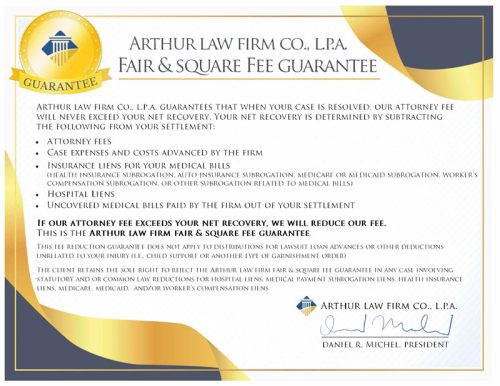
At Arthur Law Firm, we know firsthand that sometimes a settlement can’t cover all the out-of-pocket expenses a person incurs after an accident. Our Fair & Square Fee Guarantee is a commitment to you that our fee will never exceed your net recovery when your case is resolved.
Frequently Asked Questions About SSDI in Oregon, Ohio
How long does it take to receive an SSDI decision?
There is no single timeline for every disability claim. Initial applications can take several months, while appeals may take considerably longer. The length of the process can depend on factors including the stage of your claim, the amount of medical evidence involved, and whether a hearing is necessary. Some disability cases can take 18 to 24 months or longer to resolve.
What should I do after my SSDI application is denied?
Start by reviewing the denial carefully and determining which level of appeal applies to your situation. Pay close attention to the deadline for requesting the next stage of review. An experienced SSDI attorney for Oregon, Ohio can review the decision with you, explain your options, and help determine whether additional evidence or other information could strengthen your appeal.
What medical conditions can qualify for SSDI?
A wide range of physical and mental health conditions may qualify for SSDI if they are severe enough to prevent substantial employment and satisfy Social Security’s requirements. There is not a simple list of diagnoses that automatically results in approval. The severity of your condition and the limitations it creates are important parts of the evaluation.
Does my doctor have to say that I am disabled?
Your doctor’s records and opinions can provide valuable evidence about your condition and limitations, but your doctor does not make the final SSDI eligibility determination. Social Security evaluates the medical evidence along with your functional abilities, work history, and other applicable requirements.
Can I receive SSDI if I am working part-time?
It may be possible to work and still qualify for SSDI, but your earnings and work activity can affect your claim. Social Security considers substantial gainful activity when evaluating disability. Because the rules can depend on your specific circumstances, it is important to understand how your current work and earnings may affect your eligibility.