Ohio Considers New E-Bike Safety Laws
Rising e-bike and scooter injuries have prompted Ohio lawmakers to consider new safety rules that could affect children and teen riders. This article is written for Ohio parents who want to understand current e-bike laws and potential changes involving age restrictions, helmet requirements, speed limits, and registration. It explains how existing regulations differ by e-bike class, what the proposed legislation could mean for families, and how parents can help reduce accident risks and protect young riders.
Electric bikes and scooters have become increasingly popular among children, teens, and adults across Ohio. They offer a convenient way to travel, spend time outdoors, and get around town. However, their growing use has also raised concerns about rider safety, particularly as hospitals report more serious injuries involving young riders.
In response, Ohio lawmakers are considering new legislation that would establish more consistent statewide rules for electric bicycles and scooters. The proposals address several gaps in the current law, including age restrictions, helmet requirements, speed limits, and registration.
For parents, understanding these potential changes is important. Although Ohio already regulates certain types of e-bikes, the rules differ depending on the bike’s classification, and local ordinances may impose additional restrictions. Proposed legislation could significantly change what e-bike and where children and teens are permitted to ride.
Understanding Ohio’s Three E-Bike Classes
One challenge for parents is that Ohio law does not treat every electric bicycle the same way.
The state recognizes three classes of e-bikes: Class 1, Class 2, and Class 3.
These classifications refer to the speed at which the motor stops assisting, not necessarily the maximum speed a rider could reach under every circumstance. Ohio law also requires manufacturers and distributors to affix a permanent label identifying an e-bike’s class, top assisted speed, and motor wattage.
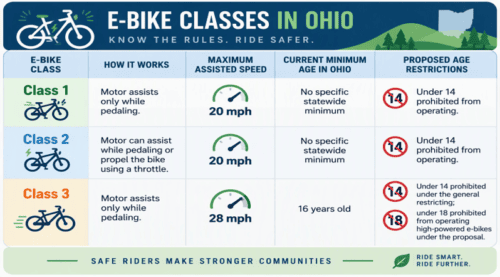
Under current state law, Class 3 operators must be at least 16 years old. Operators and passengers on Class 3 e-bikes must also wear helmets that meet applicable safety standards.
Class 1 and Class 2 e-bikes do not have the same statewide minimum age requirement, although local rules and other applicable laws may affect their use. It is best to check your local municipality regulations before you ride.
This distinction is central to the current legislative debate. A child may legally operate a Class 1 or Class 2 e-bike under existing statewide age rules, even though those bikes can reach 20 mph with motor assistance. Lawmakers are considering whether additional age restrictions are needed to address the risks to younger riders.
Why Are E-Bike Accidents Becoming a Growing Concern?
E-bikes can look similar to traditional bicycles, but their motors allow riders to travel at higher speeds with less physical effort. They are also generally heavier than conventional bicycles, which can affect balance, handling, and stopping distance.
These differences can have serious consequences during a collision. A rider traveling at a higher speed has more kinetic energy, potentially increasing the force of an impact. Accidents can result in broken bones, road rash, concussions, traumatic brain injuries, damage to internal organs, and death.
Hospitals across Ohio are reporting an increase in these injuries. According to an October 2026 report from 13ABC, Mercy Health had treated 38 e-bike injury cases over the preceding two years. The health system’s injury prevention coordinator reported that many pediatric patients required intensive care, while some patients needed emergency surgery.
The concern extends beyond Ohio. National reporting has documented a substantial increase in e-bike injuries involving children. An American Academy of Orthopaedic Surgeons report cited by Ohio lawmakers indicated that e-bike injuries among children increased by 300% between 2019 and 2023.
According to data from the United States Consumer Product Safety, Children 11-14 made up nearly 40% of all pediatric injuries related to e-bikes and scooters nationwide CPSC offers a public safety video on safe riding.
The increase has prompted doctors, safety advocates, and lawmakers to examine whether existing regulations adequately address the risks associated with these devices.
What Would the Proposed Ohio E-Bike Legislation Change?
In October 2026, state Senator Bill DeMora introduced Senate Bill 477, which proposes changes to Ohio’s laws governing electric bicycles, scooters, and other mobility devices. State Representative Eric Synenberg has also discussed introducing a related proposal.
The legislation is intended to create more consistent rules across Ohio, where individual communities have adopted different approaches to e-bike and scooter use.
Provisions described in the Senate proposal include:
- Minimum age requirements.
The proposal would prohibit children under 14 from operating e-bikes and electric scooters. It would also restrict riders under 18 from using certain rented devices or operating high-powered e-bikes, depending on the provision and vehicle classification.
- Helmet requirements.
The proposal would require riders to wear helmets, expanding beyond the existing statewide requirement for Class 3 e-bikes.
- Speed limits on paths and sidewalks.
The proposal would establish a maximum speed of 10 mph on shared-use paths and 5 mph on sidewalks. These limits are intended to reduce the risk of collisions with pedestrians and other path users.
- Registration.
Owners would be required to register personal e-bikes and scooters with the state for a proposed fee of $25. The proposal also outlines penalties for failing to comply.
- Passenger restrictions.
The proposal would limit when children under 12 could ride as passengers on devices designed to carry another person, including a requirement concerning the operator’s age.
The legislation also raises broader questions about how high-powered electric vehicles should be classified and regulated. Some products marketed as e-bikes can travel much faster than conventional models, creating uncertainty about whether they should be subject to motorcycle-style requirements instead.
These provisions are proposals, not a statement of current law. Senate Bill 477 had been introduced but had not passed the Senate as of October 30, 2026. Its final provisions, timing, and prospects for passage remain uncertain.
A separate measure, House Bill 948, also addresses e-bike operation and safety education.
Introduced earlier in 2026, it proposes measures like improving driver education, providing safety information to e-bike purchasers, and studying whether existing vehicle classifications and requirements need to change. Its status and provisions are separate from those of Senate Bill 477.
Parents should monitor the laws on e-bike use closely in the coming months.
Where Can Children Ride E-Bikes Under Current Ohio Law?
Age restrictions are only part of the picture. Parents also need to understand where different e-bike classes are permitted.
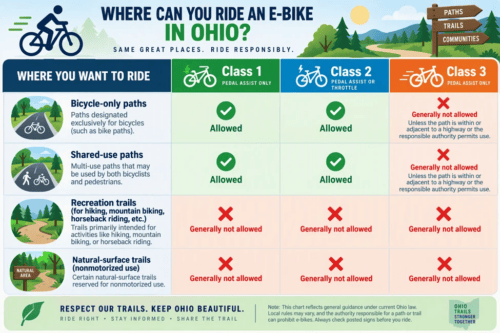
Under current Ohio law, Class 1 and Class 2 e-bikes are generally permitted on paths designated exclusively for bicycles and on shared-use paths, unless the authority responsible for the path prohibits them.
Class 3 e-bikes face tighter restrictions. They generally cannot be operated on bicycle-only or shared-use paths unless the path is within or adjacent to a highway or the responsible authority specifically permits their use.
All three classes are generally prohibited on trails primarily intended for activities like hiking, mountain biking, or horseback riding, as well as certain natural-surface trails reserved for nonmotorized use, unless the responsible authority authorizes e-bike access.
Parents should check the rules for their municipality and the specific paths their children plan to use. A bike that is permitted in one community may be subject to different restrictions elsewhere.
The Ohio Department of Transportation provides additional information about current classifications and permitted use on its electric bicycle information page.
How Can Parents Help Reduce E-Bike Accident Risks & Injuries?
Regardless of whether the proposed legislation passes, parents can take practical steps to help their children ride safely.
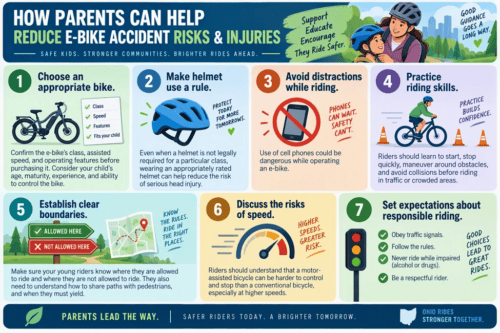
- Choose an appropriate bike. Confirm the e-bike’s class, assisted speed, and operating features before purchasing it. Consider your child’s age, maturity, experience, and ability to control the bike.
- Make helmet use a rule. Even when a helmet is not legally required for a particular class, wearing an appropriately rated helmet can help reduce the risk of serious head injury.
- Avoid distractions while riding. Use of cell phones could be dangerous while operating an ebike.
- Practice riding skills. Riders should learn to start, stop quickly, maneuver around obstacles, and avoid collisions before riding in traffic or crowded areas.
- Establish clear boundaries. Make sure your young riders know where they are allowed to ride and where they are not allowed to ride. They also need to understand how to share paths with pedestrians, and when they must yield.
- Discuss the risks of speed. Riders should understand that a motor-assisted bicycle can be harder to control and stop than a conventional bicycle, especially at higher speeds.
- Set expectations about responsible riding. Riders should obey traffic signals, and never operate an e-bike or scooter while impaired.
These precautions cannot eliminate every risk, but they can help children develop safer habits and make more informed decisions.
What Ohio Parents Should Watch for Next
The proposed legislation reflects a growing concern about the gap between the popularity of electric bikes and scooters and the rules governing their use. As they become more common among children and teens, lawmakers are considering whether statewide age limits, helmet requirements, speed restrictions, and registration could help reduce injuries and make expectations clearer.
For now, parents need to distinguish between existing Ohio law, local ordinances, and proposed legislation.
Senate Bill 477 and House Bill 948 have not established new statewide requirements simply by being introduced. Their status and any changes to their language will determine what ultimately becomes law.
Even when families follow applicable rules, e-bike accidents can still happen. A collision may involve a motorist, another rider, a pedestrian, or hazards in their path. When someone is seriously injured because another party acted negligently, the circumstances of the accident may raise questions about legal responsibility and available options for pursuing compensation.
Staying informed about changing regulations and teaching children to ride responsibly are important steps toward protecting Ohio families. If you or someone you love has been seriously injured in an e-bike accident that was not their fault, contact Arthur Law Firm (419) 782-9881 right away.